
AI as a Foundational Technological Force
The future of Artificial Intelligence (AI) is no longer merely a topic of discussion; it is now as a fundamental technological force that is rapidly and seamlessly accelerating products, services, and decision-making processes across nearly every major industry.
Drivers and Growing Impact of AI
In the coming years—driven by advancements in machine learning, data availability, and increased computational power—AI will become even more capable and accessible, playing an increasingly profound and decisive role in both daily life and business operations.
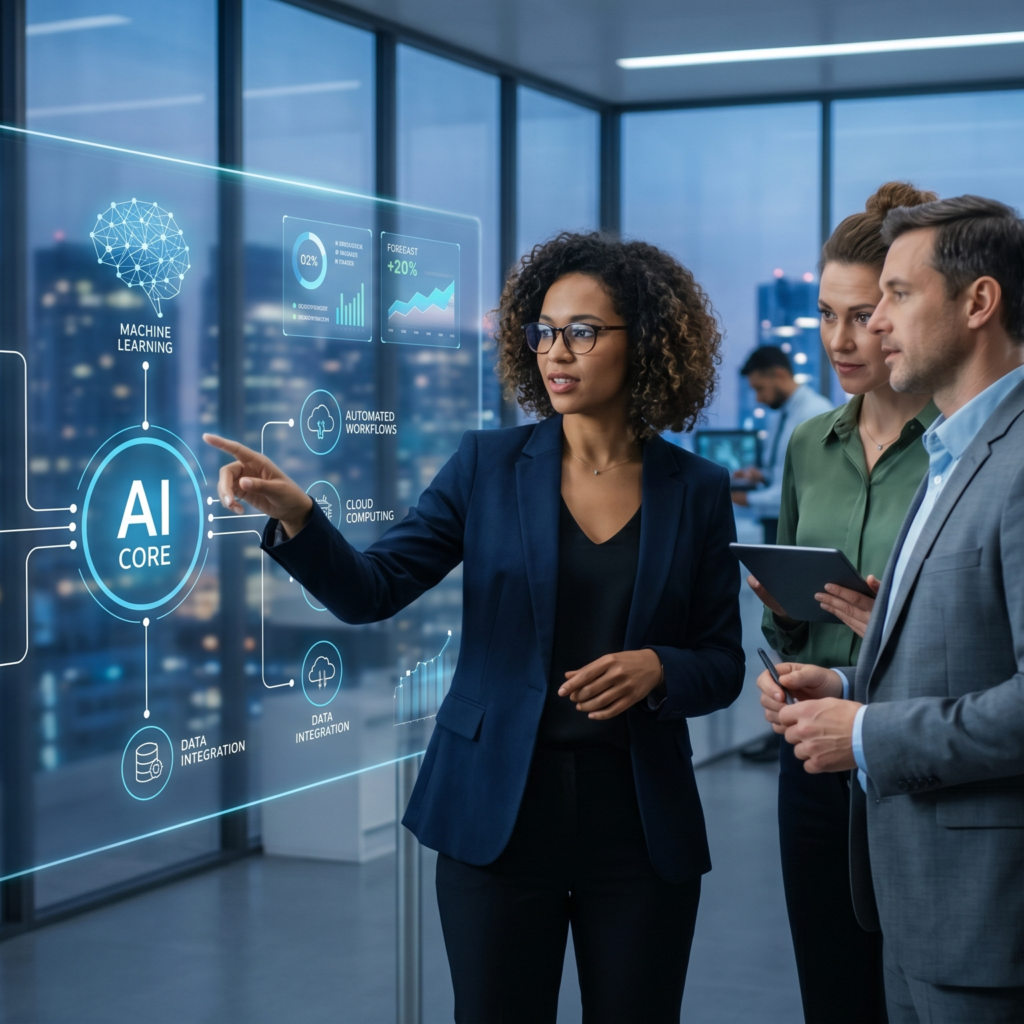
What Will Shape the Future of AI?
The future of Artificial Intelligence (AI) will be shaped by three main factors: rapid technological advancement, large-scale investment, and the growing acceptance of AI-based tools within society.
- Technological advances in deep learning, generative models, and edge computing are making AI systems faster, more accurate, and more cost-effective to deploy.
- Governments and global companies are investing more these days. As a result, fields like healthcare, finance, manufacturing, and logistics are seeing faster growth in research, better infrastructure, and real-world use of AI.”
- People and organizations are slowly getting more comfortable with AI. They now trust it for things like giving recommendations, handling automation, and even helping with tough decisions.”
When you put all these forces together, AI is no longer just a test or an experiment. It’s now moving into systems that are truly essential for the economy.
Machine Learning – The Real Engine Behind Today’s AI
Machine learning is basically what makes most modern AI work. Instead of someone writing explicit rules for every single situation, ML models learn patterns from data. And the more data they see, the better they get.
In the Future of Artificial Intelligence, ML Is Already Behind a Lot of Everyday Tech
- Recommendation engines – like the ones that suggest products, movies, or posts based on what you’ve liked before.
- Self-driving and driver-assistance systems – they take in data from sensors and react instantly.
- Recommendation engines – like the ones that suggest products, movies, or posts based on what you’ve liked before.
- Fraud detection tools – these can flag suspicious bank transactions in milliseconds.
As we keep collecting more data and algorithms get smarter, ML will handle even tougher tasks. Think dynamic pricing, real-time decisions in supply chains, and predicting when machines need maintenance – all at a large scale.
Natural Language Processing – Teaching Machines to Understand How We Talk
Natural language processing, or NLP, is what helps computers understand, respond to, and even use human language. You’ve already seen it in action – virtual assistants, chatbots, translation apps, and AI writing tools all run on NLP.
Today’s NLP models can do quite a bit:
- Figure out what you really mean when you speak a command or type a chat message
- Take a long, boring document and pull out the most important points.
- Write pretty natural-sounding text – like helping you draft emails, reports, or even code.
As NLP keeps getting better, here’s what we can expect:
- Chatbots that feel much more natural and can handle proper customer support or sales conversations.
- Voice control showing up in more places – from cars to home appliances.
- AI acting like a helpful “co-pilot” for people who do research, analysis, or writing – making their work faster and easier.
How AI Will Change Jobs and the Economy
The Dual Impact of AI on Jobs
The future of artificial intelligence is going to shake up the job market quite a bit. But it’s not as simple as ‘AI will take away jobs’ or ‘AI will create new ones.’
Task Automation, Not Whole Jobs
Research shows that AI will mostly take over certain tasks inside a job – not the whole job. At the same time, when we look at the future of artificial intelligence, it will also create new kinds of work and help people get more done.
Here are the main trends to watch
- Task automation – Routine, repetitive tasks are the most likely to get automated. Things like data entry, basic analysis, and simple customer queries.
- Productivity gains – When AI handles the boring, repetitive stuff, workers can focus on higher-value things: solving problems, being creative, building relationships. That usually means more output and often leads to new roles.
- New job categories – We’re already seeing more demand for data analysts, AI engineers, prompt designers, people who monitor AI models, and experts in AI ethics and governance.
Global studies show that a large chunk of jobs will be affected by AI in some way – especially in richer economies. But for many roles, AI will be more of an assistant or an upgrade, not a full replacement.
AI in Healthcare – Smarter, More Personal Care
Healthcare is one of the most exciting areas where AI is being used today. Medical data is complicated, and doctors are always looking for faster, better ways to diagnose problems. That makes healthcare a perfect fit for machine learning.
Right now, AI is already helping in several ways:
- It can look at medical images like X-rays, CT scans, and MRIs, and spot tiny patterns that a human eye might miss.
- It helps catch diseases early and calculate risk scores for things like cancer, heart disease, and diabetes-related complications.
- It also helps create personalized treatment plans – by taking clinical guidelines and combining them with patterns found in large sets of patient data.
In the coming years, AI is expected to improve telemedicine, remote patient monitoring, and even hospital operations. The goal is simple: help doctors and nurses deliver care that’s more precise and more efficient.
What the Future of Artificial Intelligence Means for Jobs
These days, most of the demand for AI is coming from a simple need: automate boring processes, make smarter decisions, and get real value out of large amounts of data. As a result, this is happening across almost every industry. For example, let’s look at how different sectors are using AI.
Firstly, in Healthcare
- AI helps with reading medical images, deciding which patient needs urgent care, and suggesting personalized treatments. Additionally, it can predict how a disease might progress or whether a patient is likely to be readmitted.
Similarly, in Finance
- Banks use AI for catching fraud in real time, scoring credit, and assessing risks. Moreover, AI enables algorithmic trading and helps manage investment portfolios more effectively.
In the Retail & E‑commerce sector
- Retailers rely on AI to recommend products you might like. Furthermore, it helps set optimal prices and discounts, manage inventory, and forecast demand more accurately.
When it comes to Manufacturing
- AI and deep learning help predict when a machine needs maintenance. Consequently, quality checks on production lines can be done in real time, and supply chains become more efficient.
Moving to Transportation & Logistics
- Logistics companies use AI to plan the best delivery routes and schedule shipments. In addition, they forecast demand and even run autonomous vehicles for safer, more efficient transport.
Another key area is Energy
- AI helps predict when energy equipment needs maintenance. Likewise, it optimizes smart grids and forecasts electricity demand or renewable energy generation like solar and wind.
In Cybersecurity
- Security tools use AI to spot unusual activity. As a result, they can identify threats in network traffic and respond to incidents much faster.
For Marketing
- Marketers use AI to predict customer behavior (like who might leave). Moreover, it helps create better audience segments and optimize ad targeting and creative content across different channels.
In Human Resources
- AI screens resumes, ranks candidates, and predicts which employees might leave. Furthermore, it improves onboarding and engagement using data-driven insights.
Finally, in Agriculture
- Farmers use AI and deep learning for precision farming – monitoring crops, detecting pests, and predicting yields. Therefore, this boosts both productivity and sustainability.
The good news? AI tools are becoming cheaper, easier to use, and available as ready‑made solutions. Thus, even small and medium businesses will start using AI more and more just to stay competitive.
Data Science and Artificial Intelligence – How They Work Together
Data science and artificial intelligence are closely related. In fact, in real-world projects, they often overlap quite a bit.
What is Data Science?
Data science is all about collecting, cleaning, analyzing, and visualizing data. The goal is to find patterns and help people make better decisions. It brings together:
- Statistics and math
- Programming and data engineering
- Knowledge of the specific field (like business or healthcare)
Data scientists explore datasets, build models that can predict things, and then explain their findings to the people who make decisions.
How Data Science Powers AI
AI, on the other hand, focuses on building systems that can mimic human intelligence – things like seeing, reasoning, and learning. Machine learning, which is a big part of AI, is the main bridge between data science and AI.
Here’s how they connect:
- Training data – AI models need large, good-quality datasets. Data scientists collect, clean, and prepare that data so AI can learn properly.
- Feature engineering and modeling – Data scientists figure out which features (data points) matter and choose the right algorithms. This helps AI systems recognize patterns and make accurate predictions.
- Evaluation and monitoring – Both fields work together to check how well a model is performing, spot when it starts getting less accurate (drift), and keep improving it over time.
In practice, most modern solutions use a mix of both: data science gives you the methods to understand your data, and AI gives you the algorithms and models to automate decisions and actions at a large scale.
Preparing for an AI‑Driven Future
As AI keeps getting better, it will show up in more and more areas of business and daily life. Think education, public services, creative fields, and even the tools we use for personal productivity.
So what does that mean for us?
- For individuals – You’ll need to keep updating your skills. Especially in technology, critical thinking, and understanding how to work with data.
- For companies – They need to stay aware of what’s happening in AI, and then thoughtfully bring it into their daily operations, long‑term strategy, and internal rules.
The smart way forward is to approach AI with both ambition and responsibility. Enjoy the benefits it brings, but also actively manage the risks. That’s the only way to make sure AI actually supports human wellbeing and long‑term prosperity for everyone.
Wow! it’s amazing usefull content!